

Refuse-Derived Fuel (RDF) Market Forecast 2026-2036: Market to Reach USD 11.7 billion at a 8.0 % CAGR by 2035
Refuse-Derived Fuel (RDF) Market
Refuse-Derived Fuel (RDF) Market Analysis, By Fuel Type, By Application, By Processing Method, By Component, and Region - Market Insights 2025 to 2035
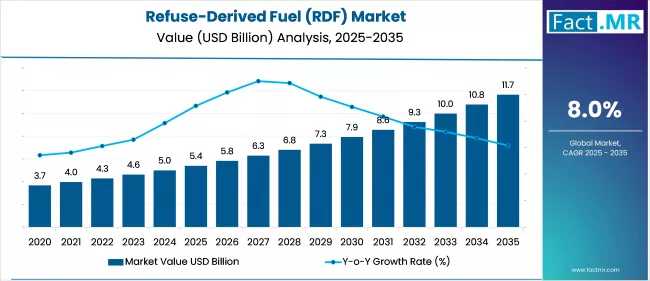
ROCKVILLE, MD, UNITED STATES, March 23, 2026 /EINPresswire.com/ -- The global energy landscape is undergoing a fundamental transformation as energy-intensive industries decouple from traditional fossil fuels in favor of sustainable alternatives. According to the latest market intelligence, the global Refuse-Derived Fuel (RDF) market is projected to surge from USD 5.4 billion in 2025 to USD 11.7 billion by 2035. This trajectory represents a robust Compound Annual Growth Rate (CAGR) of 8.0%, signaling a decisive shift in how municipal solid waste (MSW) is valued as a strategic industrial asset.As carbon taxes rise and landfill capacities vanish, RDF has emerged as the primary ""bridge fuel"" for the 21st century. By converting non-recyclable waste into high-calorific fuel, the industry is providing a dual-purpose solution: mitigating the global waste crisis while offering a cost-effective, lower-emission combustible for the world’s most energy-demanding sectors.
Get Access of Report Sample : https://www.factmr.com/connectus/sample?flag=S&rep_id=1461
The Engine of Growth: Why Decision-Makers are Prioritizing RDF
The narrative of the RDF market is no longer just about waste disposal; it is about energy security and carbon compliance. Several macro-economic drivers are currently converging to accelerate market expansion:
Stringent Landfill Mandates: Governments globally are enforcing aggressive diversion targets. In Europe and parts of North America, landfill bans on organic and combustible materials are forcing a shift toward Mechanical Biological Treatment (MBT) and RDF production.
Industrial Decarbonization: Cement manufacturing and heavy power generation—sectors that traditionally rely on coal—are increasingly integrating RDF into their fuel mix. High-grade RDF (>10 MJ/kg) offers a consistent calorific value that allows these industries to lower their Scope 1 emissions without sacrificing thermal efficiency.
Technological Maturation: Innovations in AI-driven sorting and Mechanical Heat Treatment (MHT) with sterilization have solved the ""quality consistency"" problem that historically hindered RDF adoption.
Segment Insights: The Rise of High-Grade Pellets and MBT
The market is witnessing a clear flight to quality. High-grade RDF (>10 MJ/kg) currently dominates revenue shares, favored by cement kilns that require intense, stable heat. However, the Low-grade (<10 MJ/kg) segment is identified as the fastest-growing niche, particularly in emerging economies where it serves as a transitional fuel for local power generation.
In terms of processing, Mechanical Biological Treatment (MBT) remains the gold standard, favored for its ability to stabilize organic waste while extracting high-value fuel fractions. Simultaneously, the Combined Heat and Power (CHP) application is gaining rapid traction as municipalities seek decentralized energy resilience, turning local waste directly into local heat and electricity.
Regional Dynamics: Europe Leads, Asia-Pacific Accelerates
Europe: Remains the global benchmark. With the EU Green Deal and mature waste-to-energy infrastructure, countries like Germany and the UK are pushing RDF substitution rates in cement kilns to record highs.
Asia-Pacific: This region represents the most significant growth frontier. Rapid urbanization in China and India has created a massive MSW surplus. Strategic investments in ""Clean Energy Infrastructure"" are turning this waste burden into a fuel resource.
North America: While historically reliant on landfills, the U.S. market is pivoting. The EPA’s emphasis on methane reduction and state-level renewable portfolio standards are making RDF a vital component of the North American industrial energy mix.
Competitive Landscape and Strategic Innovation
The RDF ecosystem is evolving through vertical integration and cross-border collaborations. Industry leaders are no longer just waste managers; they are sophisticated fuel processors. Recent developments, such as the expansion of the RDF Industry Group (RDFIG) and new patented catalytic pyrolysis technologies, highlight a sector that is rapidly professionalizing.
Key Industry Participants Include:
SUEZ Recycling and Recovery UK Ltd., Veolia, Renewi, Biffa, FCC Austria Abfall Service AG, Estre Ambiental Inc., Country Style Recycling Limited, EcoUrja, Carley Group Plc, Mion Ventoltermica Depurazioni S.p.A., Tana Oy, Andritz Mewa GmbH, and Hitachi Zosen.
Analyst Outlook: A $11.7 Billion Opportunity
""The transition to Refuse-Derived Fuel is no longer a 'green' elective; it is a logistical and economic necessity,"" states a leading industry analyst. ""For investors and executives, the opportunity lies in the infrastructure required to process raw MSW into high-spec pellets. As the technology for sterilization and moisture control improves, we expect RDF to become a globally traded commodity, similar to biomass or coal.""
The next decade will be defined by the ability of waste-to-energy players to provide standardized, high-calorific products that meet the rigorous demands of the global industrial sector.
To View Related Report :
Refuse-Derived Fuel (RDF) Industry Analysis in East Asia https://www.factmr.com/report/refuse-derived-fuel-industry-analysis-in-east-asia
Refuse-Derived Fuel (RDF) Industry Analysis in Latin America https://www.factmr.com/report/refuse-derived-fuel-industry-analysis-in-latin-america
Refuse-Derived Fuel (RDF) Industry Analysis in Europe https://www.factmr.com/report/refuse-derived-fuel-industry-analysis-in-europe
Refuse-Derived Fuel (RDF) Industry Analysis in Middle East & Africa https://www.factmr.com/report/refuse-derived-fuel-industry-analysis-in-middle-east-and-africa
About the Research
This comprehensive market outlook provides a deep-dive analysis into the Refuse-Derived Fuel (RDF) sector, covering 2025–2035. The study evaluates the entire value chain—from collection and processing to end-use applications in cement, power, and gasification—offering data-driven insights for stakeholders navigating the transition to a circular economy.
S. N. Jha
Fact.MR
+1 628-251-1583
email us here
Legal Disclaimer:
EIN Presswire provides this news content "as is" without warranty of any kind. We do not accept any responsibility or liability for the accuracy, content, images, videos, licenses, completeness, legality, or reliability of the information contained in this article. If you have any complaints or copyright issues related to this article, kindly contact the author above.
