

Global Lithium-Ion Battery Binders Market Outlook: Asia-Pacific Leads EV Growth with Arkema, Solvay & Kureha
Lithium-ion Battery Binders Market
Fact.MR Forecasts Lithium-ion Battery Binders Market to Surge to USD 16.63 Billion by 2036 as Global Gigafactories Scale
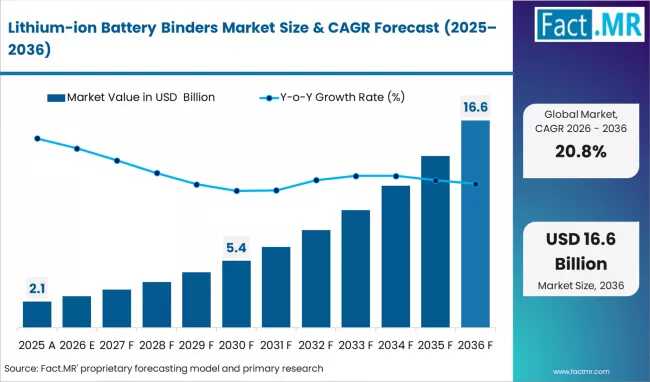
ROCKVILLE, MD, UNITED STATES, April 7, 2026 /EINPresswire.com/ -- The global Lithium-ion Battery Binders market is entering a phase of exponential industrialization. Valued at USD 2.08 billion in 2025, the market is projected to climb to USD 2.51 billion in 2026 before skyrocketing to USD 16.63 billion by 2036. This trajectory represents a sophisticated CAGR of 20.8%, creating an incremental value opportunity of USD 14.12 billion for polymer manufacturers and chemical innovators.For Details Deep insights, Please Request A sample report for Free https://www.factmr.com/connectus/sample?flag=S&rep_id=11826
Market Dynamics: From Niche Specialty to Industrial Commodity
The transition of battery binders from niche specialty chemicals to high-volume industrial polymers is being dictated by the rapid scaling of TWh-scale battery production. As electrode assemblies become more complex, the role of the binder—the ""glue"" that maintains electrochemical structural integrity—has become a mission-critical component for battery longevity and safety.
Key Market Fundamentals (2026–2036)
Metric Details
Market Value (2026) USD 2.51 Billion
Market Value (2036) USD 16.63 Billion
CAGR (2026-2036) 20.8%
Dominant Material PVDF (63% Market Share)
Primary Driver Electric Vehicle (EV) Production (58% Application Share)
Segmental Insights & Technical Leadership
1. Material Analysis: PVDF vs. Water-Based Systems
Polyvinylidene Fluoride (PVDF): Dominates the landscape with a 63% share. It remains the gold standard for cathode binding due to its unmatched chemical resistance and thermal stability.
CMC & SBR: These water-based systems are the fastest-growing categories for anode applications. Their adoption is driven by the industry's shift toward ""green"" manufacturing, eliminating the need for costly organic solvent recovery.
2. Application Focus: The EV Juggernaut
The Automotive sector accounts for 58% of total demand. The push for higher energy density and longer cycle lives in EVs is forcing OEMs to move toward specialized binder architectures that can accommodate the volume expansion of silicon-graphite anodes.
Regional Outlook: India and China Lead the Charge
Asia-Pacific remains the undisputed engine of growth, though regional dynamics are shifting toward domestic localization:
India (22.3% CAGR): The global frontrunner in growth, propelled by ""Atmanirbhar Bharat"" and PLI schemes targeting domestic cell manufacturing.
China (21.0% CAGR): Sustains dominance through sheer infrastructure scale and a mature supply chain that integrates raw material processing with cell assembly.
United States (18.5% CAGR): Witnessing a ""resilience"" phase driven by Inflation Reduction Act (IRA) incentives, forcing a localized supply chain for battery materials.
Supply Chain & Competitive Landscape
The competitive theater is no longer just about chemistry; it is about volume consistency and qualification status. Tier-1 cell manufacturers are increasingly locking in long-term contracts with qualified suppliers to mitigate risks of material shortages.
Top Tier Players:
Arkema, BASF SE, LG Chem, DuPont, Solvay, Trinseo, TORAY Industries, Inc., DAIKIN Industries, Ltd., Synthomer PLC, and ZEON Corporation.
Analyst View: > ""We are seeing a structural shift in procurement. Cell operators who delay adopting next-generation, compliance-grade binders face narrowing competitive windows. Specification requirements are tightening, and the market is consolidating around suppliers who can guarantee high-purity volumes,"" says Shambhu Nath Jha, Principal Consultant at Fact.MR.
Future Outlook & Investment Opportunities
The future of the market lies in Solid-State Battery transitional architectures and Bio-based polymers. For decision-makers, the ""Opportunity Matrix"" suggests a move toward:
Investment in Water-Based Formulations: To align with tightening environmental regulations in Europe and North America.
Silicon-Anode Compatibility: Developing binders that can survive the 300% volume expansion of silicon particles is the next ""billion-dollar"" technical hurdle.
Strategic Action for Executives
Procurement: Secure multi-year off-take agreements for PVDF to hedge against price volatility.
R&D: Focus on ""drop-in"" solutions that require zero changes to existing gigafactory coating lines.
For instant access to this report, click "Buy Now" or connect with our analyst for customization: https://www.factmr.com/checkout/11826
To View Related Report
Electric Car Battery Charger Market https://www.factmr.com/report/4/electric-car-battery-charger-market
Fire Alarm Battery Market https://www.factmr.com/report/595/fire-alarm-battery-market
Battery Testers and Analyzers Market https://www.factmr.com/report/1836/battery-testers-and-analyzers-market
Automotive Start-Stop Battery Market https://www.factmr.com/report/2322/automotive-start-stop-battery-market
Battery Management System Market https://www.factmr.com/report/2447/battery-management-system-market
S. N. Jha
Fact.MR
+1 628-251-1583
email us here
Legal Disclaimer:
EIN Presswire provides this news content "as is" without warranty of any kind. We do not accept any responsibility or liability for the accuracy, content, images, videos, licenses, completeness, legality, or reliability of the information contained in this article. If you have any complaints or copyright issues related to this article, kindly contact the author above.
